Tasmanian Thipsels
A research blog
Chronological list of posts
Alerts for new posts: 
M4 and M76
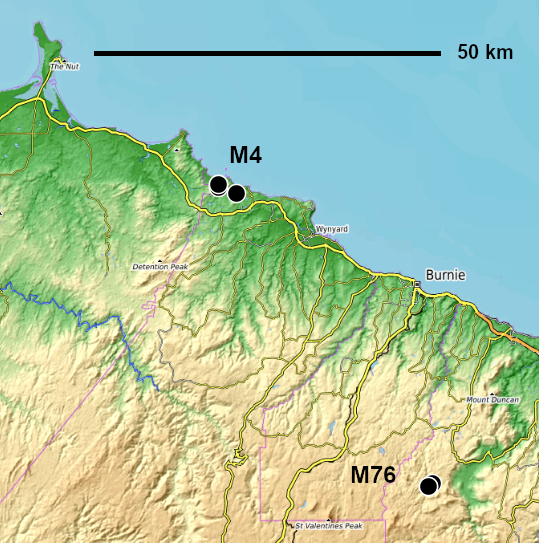
This week I managed to collect a male of M4 for light-microscope work. I also failed yet again to find another M76 male. The two species are narrow-range Northwest endemics (see map below).
Update: It's an M16, not an M4. See next post.
M4 is one of the Northwest's undescribed "dysmicodesmoid" thipsels. I call them "dysmicodesmoid" because the long, straight and sturdy gonopod telopodites end in a few small processes, something like the telopodites of the much larger Dysmicodesmus jeekeli. M4 has only been found between Sisters Beach and Boat Harbour:
1M, Sisters Creek, 1999-10-02, R. Mesibov and K. Bonham (QVMAG, QVM:23:51807)
1M+2F, Sisters Beach Road, 2017-10-16, R. Mesibov (QVMAG, QVM:2017:23:0207)
3M, Sisters Beach Road, 2017-10-29, R. Mesibov (QVMAG, QVM:2017:23:0224)
1M, Boat Harbour - Ferris property, 2024-08-10, R. Mesibov (TMAG, J7253)
1M, Sisters Creek, 2026-07-05, R. Mesibov (to be deposited in TMAG)
Like most "dysmicodesmoid" thipsels, M4 is very hard to find. The latest male turned up in dripping wet eucalypt leaf litter in riparian wet sclerophyll forest after about an hour's searching. It was easy to confuse in the field with the similarly sized and coloured (but more abundant) juveniles of Procophorella innupta.
M76 has only been found near Loyetea, and my M76-targeted searches have been more than a little frustrating: 4 successes at 21 sites on 8 field days within the small known range. I haven't seen a male since 2022:
5M+5F, Loyetea Road, 2022-11-18 (TMAG, J6594)
6M+6F, Loyetea Road, 2022-11-19 (TMAG, J6593)
2M+3F, Loyetea Road, 2022-12-06 (TMAG, J6592)
FAIL (3 sites), Loyetea Road, 2022-12-06
FAIL (5 sites), Loyetea Road and W of Loyetea Road, 2025-10-27
FAIL (2 sites), Loyetea Road, 2025-10-30
10F, Loyetea Road, 2025-11-21 (TMAG, J7990)
FAIL (2 sites), E of Loyetea Road, 2025-12-04
FAIL (5 sites), Loyetea Road, 2026-07-06
Live M76 are thin, reddish and disinclined to curl up when disturbed. What makes them especially difficult to find is that they have a jackpot distribution on a small scale. A 1 m2 patch of wet sclerophyll leaf litter might have several adults, with no adults at all in nearby 1 m2 patches.
When I write "site" above, I'm referring to 200-400 m2 of georeferenced forest floor over which I searched selected litter patches for 30-60 minutes. The 2025-11-21 search was along and ca 10 m either side of a ca 100 m transect.
2026-07-07; updated 2026-07-09