Tasmanian Thipsels
A research blog
Chronological list of posts
Alerts for new posts: 
The iNaturalist problem
The image below was posted on iNaturalist by local naturalist Alan Melville in 2019. He identified the subject as a millipede.
A year later the ID was refined to "Polydesmida" by the Austrian entomologist Nikolaus Szucsich. In 2024 the American entomologist Julian Fuchs correctly placed the millipede in Dalodesmidae.
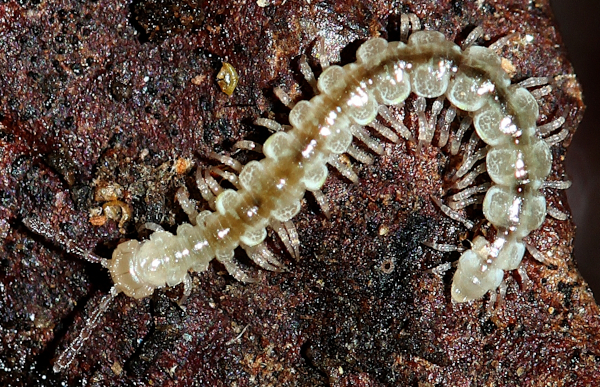
Thipsel from the Emu River valley in Burnie
Image by Alan Melville, modified
How did Fuchs decide it was a dalodesmid? He didn't say. Very, very few iNaturalist observers and commenters explain their identifications or cite a reference (even another iNaturalist ID).
Given the state of thipsel taxonomy, "Dalodesmidae" is as far as I could go, too, from the image above. I might have gone further if the specimen had been captured and preserved in a museum collection, but that particular thipsel probably lived out its short life in the bush, died and got naturally recycled.
James Douch, a Sydney-based zoologist, has started a Millipede Gonopods project on iNaturalist. It's a great idea, but there are technical obstacles to imaging gonopods in situ in ways that make species identifiable. Those obstacles are even bigger when the subjects are tiny. The most useable images are of gonopods dissected out and viewed through a microscope from different angles or focus depths.
The subject in the iNaturalist image below, however, was identified to species as the thipsel Ginglymodesmus tasmaniensis. How did that happen?
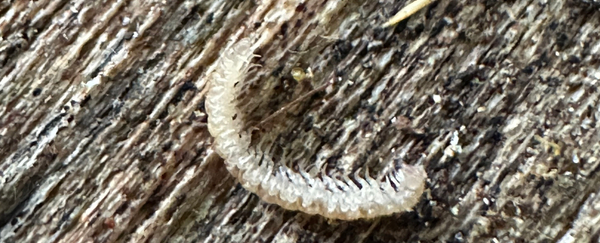
Adult male Ginglymodesmus tasmaniensis Mesibov, 2005 from the Forth Falls track
Image by Andrew He, modified
The observation comes from a Central North Field Naturalists excursion on 2025-05-04. I was walking with the photographer, Andrew He, when we found the millipede. After Andrew snapped the image I collected the specimen, preserved it, ID'ed it and deposited it in the Tasmanian Museum and Art Gallery (reg. no. J7562).
iNaturalist does a great job of encouraging natural history observations and educating its observers. The platform also provides biological records for aggregation by GBIF and the Atlas of Living Australia.
Unfortunately, millipedes in general (and thipsels in particular) can't usually be identified to species, or sometimes to genus, or sometimes even to family or order, from a picture of the whole animal. Species ID of dalodesmid thipsels, in particular, just isn't possible from images like the two above. That's the iNaturalist problem.
2026-07-04