Tasmanian Thipsels
A research blog
Chronological list of posts
Alerts for new posts: 
A Victorian genus in the NW
This week I was surprised to recognise that one of the undescribed Tasmanian thipsels belongs in a Victorian genus.
I erected the genus Polydactylogonus in 2025 for a tiny millipede collected two years earlier by Nick Porch (Deakin University) from the Baw Baw area in the mountains east of Melbourne. The only species then known, P. sanctogwinear, grows to ca 7 mm long. Nick and his students have subsequently found the same species at other mountains-east-of-Melbourne localities. Here's what it looks like:
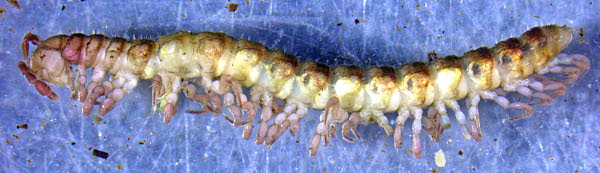
Polydactylogonus sanctogwinear Mesibov, 2025
Male from Mt Donna Buang, VIC, image by Nicholas Porch
The genus name means something like "many-fingered gonopod". There are five separate processes crowded together and fanning out at the end of each gonopod telopodite:
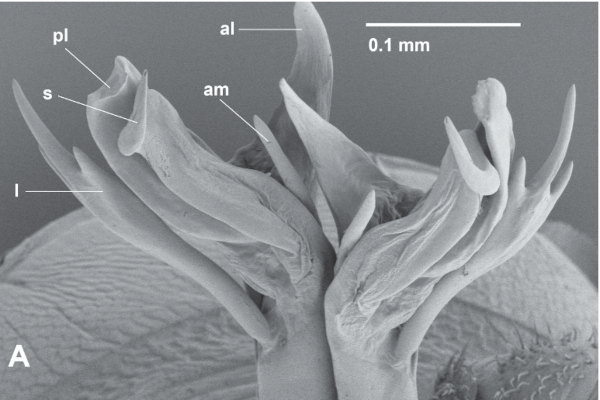
Gonopod tips of Polydactylogonus sanctogwinear
Male from Mt Baw Baw, VIC; image from original description
Nick suggested to me in an email that Polydactylogonus might also occur southwest of Melbourne in the Otway Ranges, because that's a not-uncommon biogeographical pattern for some litter invertebrates. I checked some old gonopod images I'd snapped of Museum Victoria specimens, and sure enough, a second Polydactylogonus species had been collected in the Otways in 1991.
But I also realised that a Tasmanian thipsel, codename M16, was a third Polydactylogonus species. As in the two Victorian species the gonopod tips have separate processes fanning out, and the process carrying the end of the spermatic groove (the most important process for the male at mating time, s in the SEM image) is in the same relative position.
The Tasmanian Polydactylogonus is a NW endemic found from the Blythe River west and south to the Guildford area, but (so far) not south of the Arthur River:
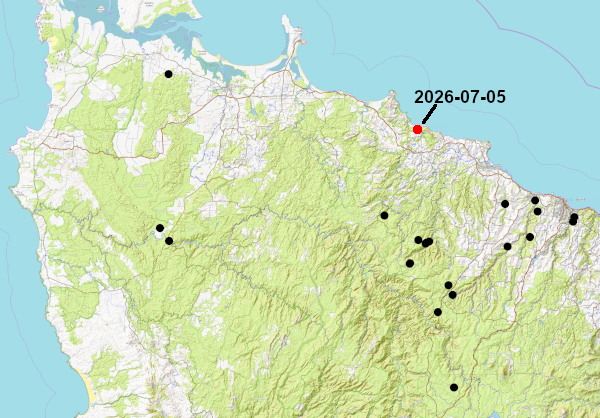
Localities for "M16" in NW Tasmania
There are 27 males of M16 awaiting description in the Queen Victoria Museum and Art Gallery and the Tasmanian Museum and Art Gallery. They were collected by Kevin Bonham, Renate van Riet and me between 1991 and 2024. It would be fairly easy to collect fresh material in the Burnie area, for DNA work.
2026-07-02; updated 2026-07-08, see here