Tasmanian Thipsels
A research blog
Chronological list of posts
Alerts for new posts: 
What's a "thipsel"?
Thipsels are Tiny H+19 Polydesmida in Soil and Litter. They're ca 4-10 mm long as adults. A handsome example is Asphalidesmus parvus (below) from southeast Tasmania.
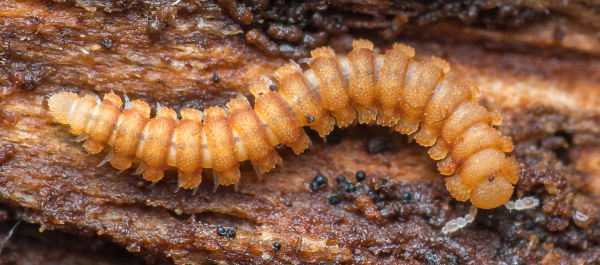
Asphalidesmus parvus (Chamberlin, 1920)
Image by Benjamin Fabian, used with permission
"H+19" and "H+20" refer to the two body plans found in almost all Polydesmida; see here for more information and diagrams.
Generally speaking, larger Polydesmida are H+20 as adults and smaller species are H+19 (see below). All the tiny Tasmanian Polydesmida are H+19, but there are many Polydesmida elsewhere in Australia and overseas that are both tiny and H+20. For purposes of this Tasmanian website I'll call all tiny Polydesmida "thipsels" rather than "th19ipsels" and "th20ipsels"!
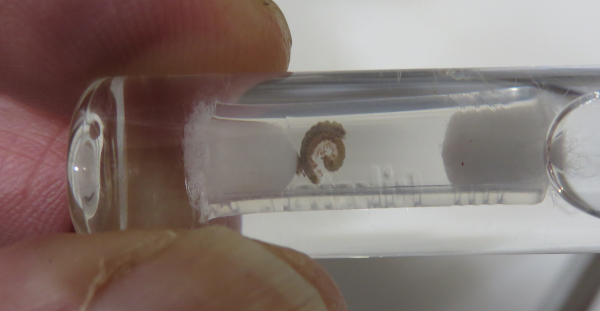
"Tiny" here means so small they're usually overlooked, or mistaken for a bit of plant debris. In the image below there are two adult thipsels inside the cotton-plugged tube.
Overlooked, maybe, but most native Tasmanian Polydesmida are thipsels, and are mainly undescribed (see checklist for genus and species details):
Adult length more than 10 mm (69 spp; H+20/H+19 53/16)
Aethalosoma (1 sp)
Dicranogonus (1)
Notodesmus (1)
Pogonosternum (2)
Somethus (2)
- - - - -
Atalopharetra (4)
Atrophotergum (1)
Bromodesmus (4)
Dasystigma (4)
Gasterogramma (8)
Kebodesmus (1)
Lissodesmus (19)
Noteremus (2)
Paredrodesmus (2)
Tasmaniosoma (14)
Tasmanodesmus (1)
Tasmanopeltis (1)
Adult length about 10 mm (16 spp; H+20/H+19 1/15)
Atrophotergum (3 spp)
Lissodesmus (1)
Paredrodesmus (4)
Tasmaniosoma (8)
Adult length less than 10 mm (ca 86 spp; all H+19)
Asphalidesmus (3 spp)
Atrophotergum (2)
Ginglymodesmus (3)
Procophorella (2)
Setoisenoton (1)
- - - - -
undescribed Polydesmida (ca 75 spp)
As you can see from the checklist, my taxonomic contributions over the years have mainly focused on larger species. I put off working on most of the thipsels because they're hard to find and hard to study. Time now to stop procrastinating...
2026-07-01